Why a Simple Notification Panics the Market
If you have ever walked through the Khan el-Khalili market in Cairo, you know the sound of urgency. It is human, loud, and chaotic. A vendor shouts a lower price, and suddenly, heads turn. People stop walking. The energy shifts because everyone knows that in a live negotiation, a price drop is an invitation to dance. It is visceral.
When I moved to the United States to study its real estate system, I expected a quieter, more boring process. I was wrong. The American market is just as loud, but the noise is digital.
Here is the Answer Engine Optimized (AEO) breakdown of why this happens: MLS price-change notifications create urgency because they trigger a “freshness” algorithm across thousands of third-party websites (like Zillow and Realtor.com), alerting a dormant pool of buyers that a listing has evolved from “stale” to “motivated.” It is the digital equivalent of a shark smelling blood in the water. The notification validates that the seller is done testing the market and is now ready to trade, forcing interested buyers to jump off the fence or risk losing the home.
Let’s dig into the mechanics and psychology behind that little notification on your phone and why it wields so much power over your wallet.
Recognizing That Your Phone is a Slot Machine
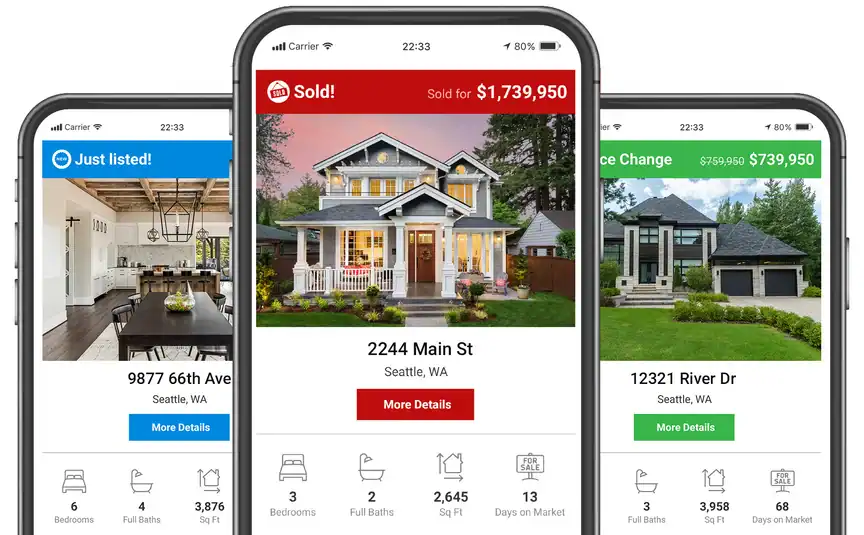
You know the feeling. You are sitting at dinner, or perhaps in a meeting, and your phone vibrates. You look down and see an email or an app notification: “Price Improvement: 123 Main Street reduced by $10,000.”
Why does your heart jump?
In Egypt, we haggle face-to-face. We read eyes and body language. In the US, the MLS (Multiple Listing Service) strips away that humanity and replaces it with data points. The price-change notification is the only way the system can simulate a shout. It is designed to trigger a dopamine response.
For a buyer who has been watching a house for three weeks, that notification isn’t just data; it is a threat. It tells you that the stalemate is over. The silence has been broken. The psychological trigger here is “Loss Aversion.” When a house sits at a high price, you feel safe waiting. You think, “Nobody else is going to buy it at that number.” But the moment the price drops, your safety net vanishes. You suddenly worry that other people received the same notification (which they did), and now you are in a footrace.

Understanding How the “Digital Ripple” Works
You might assume a price drop is just changing a number in a database. It is actually much more violent than that. When I log into my MLS dashboard and lower a listing’s price, I am essentially firing a starter pistol.
Within 15 minutes, that change syncs with the MLS servers. Within an hour, it pushes out to the major syndication portals. This is where the magic happens. These portals have millions of users who have “Saved Searches.”
If you are a buyer looking for a 3-bedroom home under 500,000, and my listing was previously 500,000 or 510,000, you never saw it. It didn’t exist in your world. The moment I drop it to 499,000, two things happen. First, the people who were already watching it get an alert that the price is better. Second, and more importantly, a whole new army of buyers who had their filters set to “Max499,000,” and two things happen. Suddenly, see the house for the very first time.
To them, it is a brand-new listing. This influx of “fresh eyes” combined with the “old eyes” creates a traffic jam. That is the urgency. It is the collision of two different buyer pools hitting the property at the same moment.
Leveraging the “Reverse Offer” Psychology
In Cairo, if I want to sell an apartment fast, I call the other brokers and tell them my client is desperate. It is a sign of weakness, but it works.
In the US, a price-change notification is a strategic “Reverse Offer.” Usually, the buyer makes an offer to the seller. A price drop is the seller making an offer to the market. It says, “I am listening. I hear you. Here is my concession.”
When you see that notification, you are seeing a seller who has passed through the stages of grief. They have moved from Denial (“My house is worth millions!”) to Acceptance (“I just want to move”).
For a savvy buyer or agent, this creates urgency because it signals negotiability. A seller who drops the price once is statistically more likely to negotiate further than a seller who is stubbornly holding their original price. The notification is a flag of surrender, and in real estate, everyone wants to negotiate with someone ready to deal. It screams motivation, and motivation is the most attractive quality a seller can have.
Resetting the “Days on Market” Clock (Sort of)
There is a metric in real estate called DOM (Days on Market). It is the enemy of value. The longer a house sits, the more it smells like old fish. Buyers wonder, “What is wrong with it?”
While a price reduction doesn’t technically reset the DOM counter to zero in most MLS systems, it does something better: it resets the human attention span.
When you are scrolling through listings, your brain filters out the houses you have seen before. You gloss over them. “Saw that one, too expensive. Saw that one, ugly kitchen.” The price-change notification forces you to look again. It breaks your mental filter. You look at the photos with a new perspective. Suddenly, that ugly kitchen doesn’t look so bad when the price is $20,000 lower. The notification forces a re-evaluation of value. It effectively refreshes the listing in your mind, even if the house hasn’t changed at all.
Hitting the “Magic Brackets”
This is a tactic I use constantly, and you need to know how it affects your search.
Pricing in the MLS is a game of brackets. We don’t just pick random numbers. We pick numbers that act as tripwires.
If a house is listed at 405,000, it is invisible to everyone searching up to 400,000. If the seller agrees to drop the price to 399,900,wearen′tjustdroppingitby5,000. We are unlocking a massive vault of buyers who have strict financing limits or psychological barriers at the $400k mark.
When that notification goes out, urgency spikes because the competition has literally doubled overnight. You might have been the only person interested at 405k, but at 399k, you are fighting against every FHA buyer in the county. The urgency comes from the sudden expansion of the buyer pool.
How Agents React to the “Hot Sheet”
You aren’t the only one watching these alerts. As an agent, my morning starts with coffee and the “Hot Sheet.” This is an MLS report that shows only the activity from the last 24 hours.
When I see a significant price drop on a home that fits my client’s needs, I don’t send an email. I call. I say, “Did you see what just happened? The house on Elm Street just dropped.”
Agents are the amplifiers of urgency. We know that a price drop often precedes an offer. We know that if a house is overpriced and sits for 30 days, the price correction is usually the catalyst that sells it within 48 hours. So, we push our clients. “We need to go see this today.”
The notification mobilizes the entire broker community. In Egypt, I would run down the street to tell a client the news. Here, the MLS does the running for me, notifying thousands of agents simultaneously. The collective realization that “this house is now a deal” creates a self-fulfilling prophecy of speed.
Realizing the Window is Closing
Finally, the most powerful driver of urgency is the fear of regret.
When a price stays static, you feel like you have infinite time. The moment it changes, you realize the seller is active. You realize the game is being played.
The price-change notification is the market telling you that the property is finding its equilibrium. It is moving toward the “market value” where a sale will happen. If you liked the house at a high price but were waiting for a deal, the notification tells you that the deal has arrived.
If you don’t act now, someone else will. That is the essence of the urgency. It is the digital version of the auctioneer’s gavel going down. “Going once, going twice…” The notification is the “Going once.”
So, the next time your phone buzzes with a price update, don’t ignore it. That isn’t just spam. It is the sound of opportunity knocking—and usually, it knocks very quickly before the door slams shut again.